
Seeds of Success in Lassen Volcanic National Park
Through a collaboration between Sierra Institute & Lassen Volcanic National Park, botany specialist Colleen Egan and seasonal technician Tori Childress were able to spend the summer collecting native seeds for the Seeds of Success program.
Seed by seed in Lassen’s burn scar
When people picture putting a forest back together after a fire, they tend to picture trees: crews moving across burned landscapes with planting bars and bags of seedlings, trying to replace what was lost. It’s a picture of post-fire restoration in the West that we’re all growing accustomed to. On social media, we see statistics from agencies, industry, and nonprofits celebrating the hundreds of thousands of trees replanted across fire-scarred landscapes. And while tree planting is one important approach to post-fire reforestation, it is far from the whole picture.
Reforestation is slow, expensive, essential work. But a conifer seedling planted into bare, sun-baked ground is a seedling planted alone, without the biodiversity and ecological networks that existed before the high-severity burn. Long before a tree casts shade over a burn scar, grasses and wildflowers are doing some of the first and most important work. They hold soil in place, help keep sediment out of creeks, and can determine whether native plants or invasive weeds claim the ground first.
Quite rarely do native grasses and forbs get a planting crew of their own.
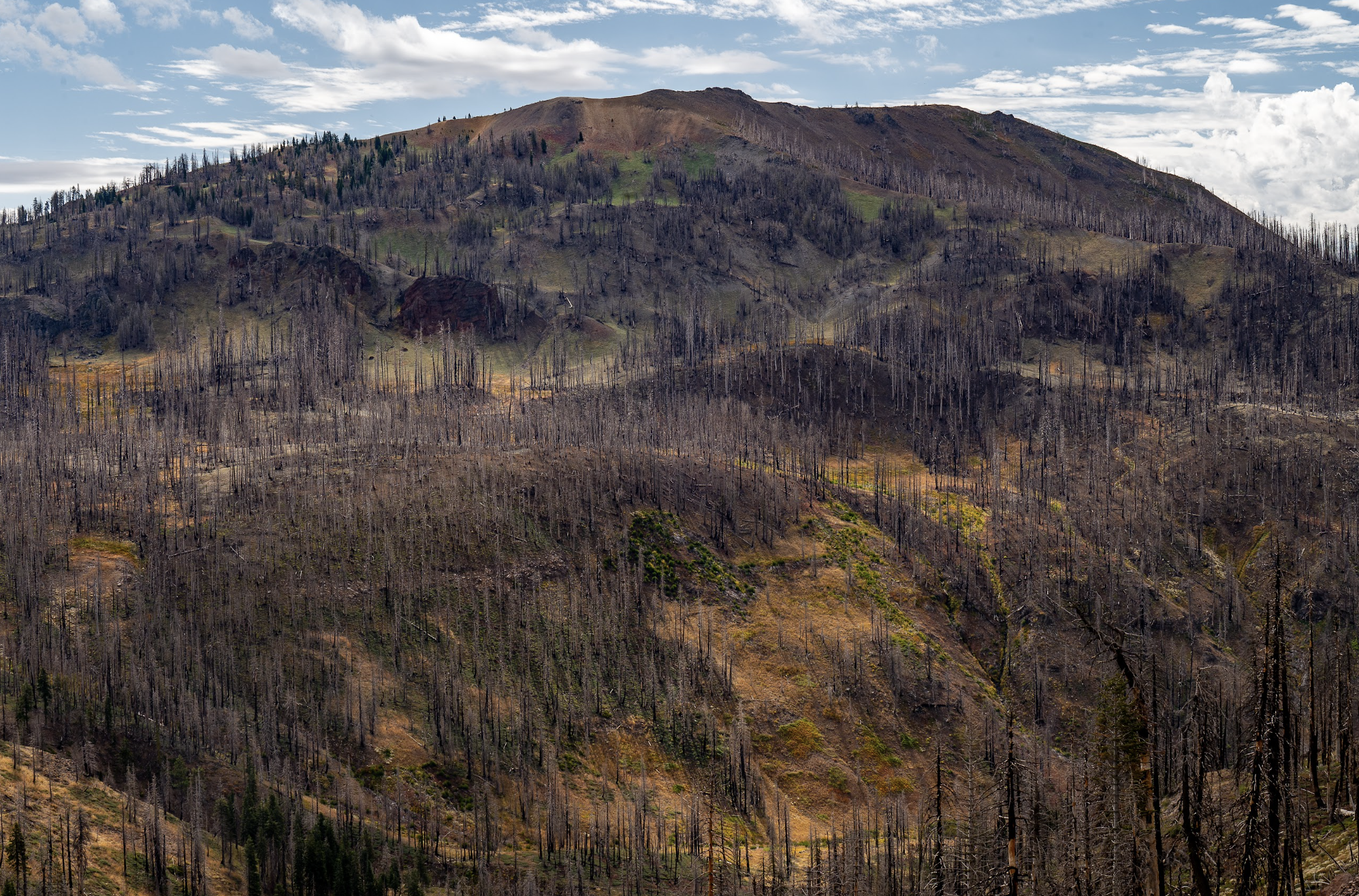
A burned landscape 5 years after the Dixie Fire seen from California State Route 44 inside Lassen Volcanic National Park
In Lassen Volcanic National Park (LAVO), the 2021 Dixie Fire burned through a large share of the park on its way to becoming California’s largest single wildfire in recorded history at 963,309 acres. This past season, for the first time, the park ran its own seed collection for the Seeds of Success program. The effort was started by Colleen Egan, botany specialist for LAVO, and carried out largely by Victoria Childress (Tori), a seasonal botany technician, both of whom were hired by Sierra Institute in partnership with the park. Sierra Institute has been partnering with LAVO since 2018 to build collective capacity to address the Park’s resource management needs. Tori spent the summer working roadsides and upland slopes throughout LAVO, gathering seed from ten California native species with a bucket, a clicker, and a binder thick with protocol.
Laying the groundwork
Colleen brought Seeds of Success to Lassen because she wants the park to have a strong native plant materials program of its own. She completed the program’s training, then brought Tori on to do the same and take on most of the seed and data collection, since Colleen’s work spans many other projects in the park.
The planning started the winter before. Colleen chose the species the park would collect, then scouted sites for each one: places where the plants grew in abundance, spread across an elevational gradient so seed would ripen at different times, and Tori could keep collecting from early summer into fall. Colleen’s six years of working in LAVO as a botanist made scouting easier. “My local knowledge of the park’s geography helped a lot,” she said.
Early in the field season, the two spent ample time in the field together. Colleen taught Tori about each species and how to identify them, along with the other associated native vegetation growing within each collection polygon, which the protocol requires collectors to record. Once Tori could work on her own, Colleen said, “She was off to the races.” Colleen continued assisting Tori with scouting, collecting voucher specimens, taking site photos, and gathering seed herself, and the two met almost daily to track which species at which sites were ready. When late summer brought the busiest stretch of ripening, volunteers and other Seeds of Success crews joined their collection efforts.
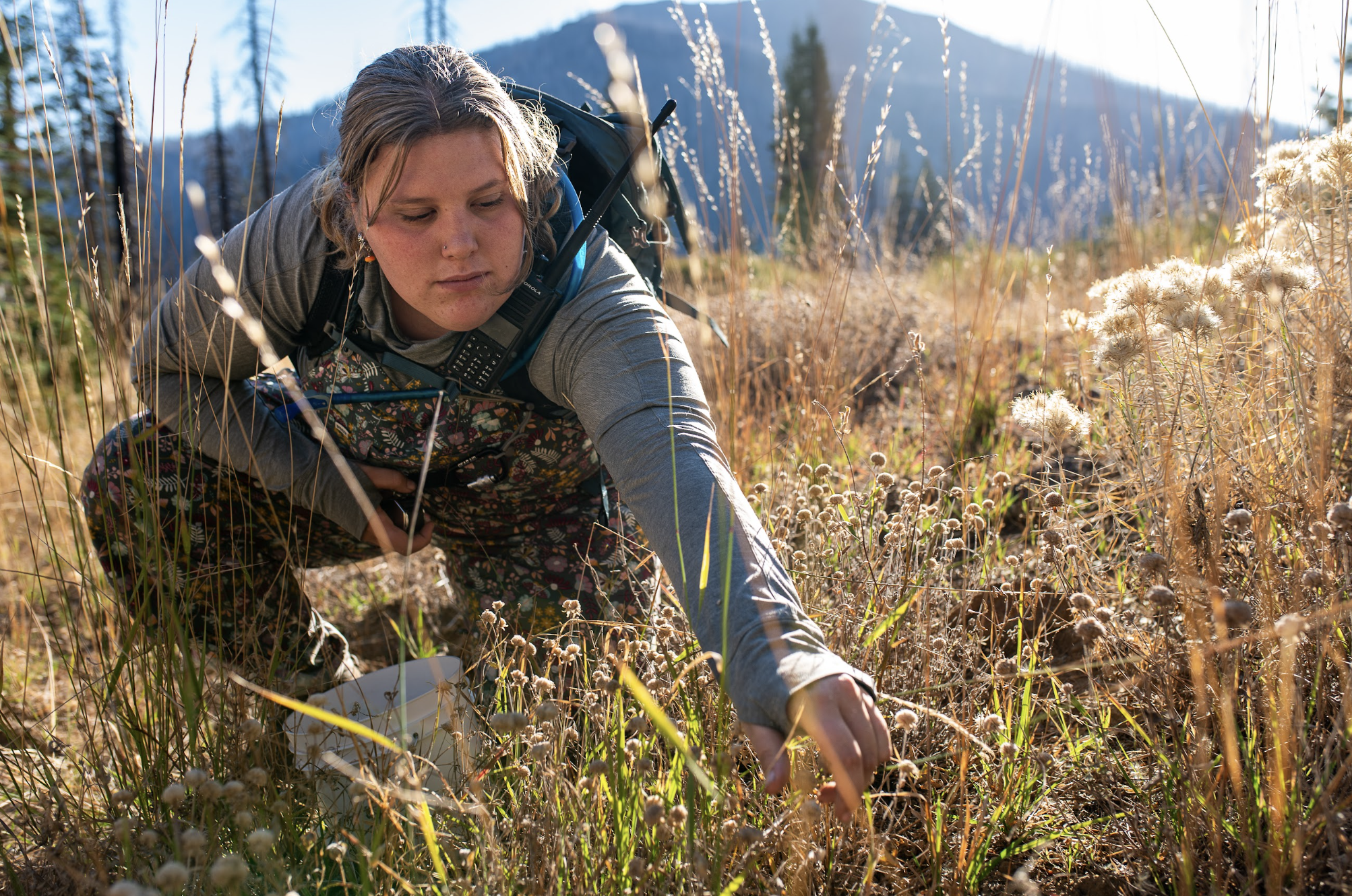
Tori collects Mountain pennyroyal (Monardella odoratissima) seeds from a roadside collection site in Lassen Volcanic National Park
Twenty-five years of seed
Seeds of Success, led by the Bureau of Land Management (BLM), began in 2001 as a seed-banking program: collect wild seed, document where it came from, and put it into long-term storage to protect it against an uncertain future. Research came later. More recently, as megafires have reshaped landscapes across the West, the program has added another step: amplification—the grow-out of wild-collected seed on farms until there is enough to sow a burn scar rather than a garden bed.
Today, the national collection holds more than 27,000 native seed collections. In 2023, the National Park Service and U.S. Fish and Wildlife Service joined the BLM through an interagency agreement to help carry the work forward.
But none of this happens quickly. Seeds collected in Lassen two years prior, including woolly mule’s ears and mountain pennyroyal, are only now going into amplification.
“It takes time,” Tori said. “It’s not immediate.”
Choosing what survived
Paradoxically, some of the most valuable seeds in the park may come from the places that look the most damaged. When the team scouts look for collection sites, they often look inside the burn scar first.
“We’re looking for species that have persisted in the burn scar and demonstrated their ability to establish in these conditions,” said Tori.
The species selected for collection each year at LAVO are chosen with the realities of post-fire recovery in mind. They need to grow across much of the park, particularly on upland and intermediate sites rather than in meadows or wetlands. After a fire as large and varied as the Dixie Fire, restoration requires seed that can take root across a range of conditions.
The plants also need to be good competitors—species capable of establishing quickly and holding their ground against invasive plants, which can move into the park on visitors’ boots and take advantage of the bare, disturbed soil left behind by fire. Burn scars are especially vulnerable to that invasion.
Squirreltail, for example, establishes aggressively and sends out roots that help hold soil against erosion. Blue wildrye and California brome can fill in quickly, creating ground cover that helps shade out plants that don’t belong. Together, these grasses and wildflowers are not simply placeholders until the trees return. They are part of the first layer of recovery.
The ten species Tori collected this season were:
- Blue Wild Rye Elymus glaucus
- Slender wheatgrass Elymus trachycaulus
- Squirreltail Elymus elymoides
- California brome Bromus carinatus
- Slender penstemon Penstemon gracilentus
- Roezl’s penstemon Penstemon roezlii
- Naked buckwheat Eriogonum nudum
- Mountain pennyroyal Monardella odoratissima
- Woolly mule’s ears Wyethia mollis
- Jessica’s stickseed Hackelia micrantha

Wooly Mule’s Ears (Wyethia mollis) seeds during a collection in Lassen Volcanic National Park
A carefully considered protocol
For a program devoted to gathering seed, Seeds of Success is also ethically devoted to leaving it behind. Collectors take no more than 20% of the seed that is ripe on a given day. They can return to the same population as more seed ripens, but never collect more than that threshold.
If a population is collected two years in a row, it is then left alone for three years. Every collection is mapped as a polygon, creating a record of exactly where seed was gathered and helping ensure that no one accidentally harvests the same plants twice.
Even the word “population” carries a precise meaning. Plants are considered part of the same population when they share a seed zone—similar elevation, humidity, and growing season—and when nothing significant separates them, whether a gap of more than a kilometer or a geographic barrier.
Lassen supplies barriers in abundance. The Sulphur Works geothermal area divides one stretch of plants into distinct populations, while ridgelines, granite slopes, and barren volcanic ground do the same across the park. Practicality matters, too. A four-mile hike to a collection site is time not spent collecting, which is one reason many of the targeted populations grow along the roads.
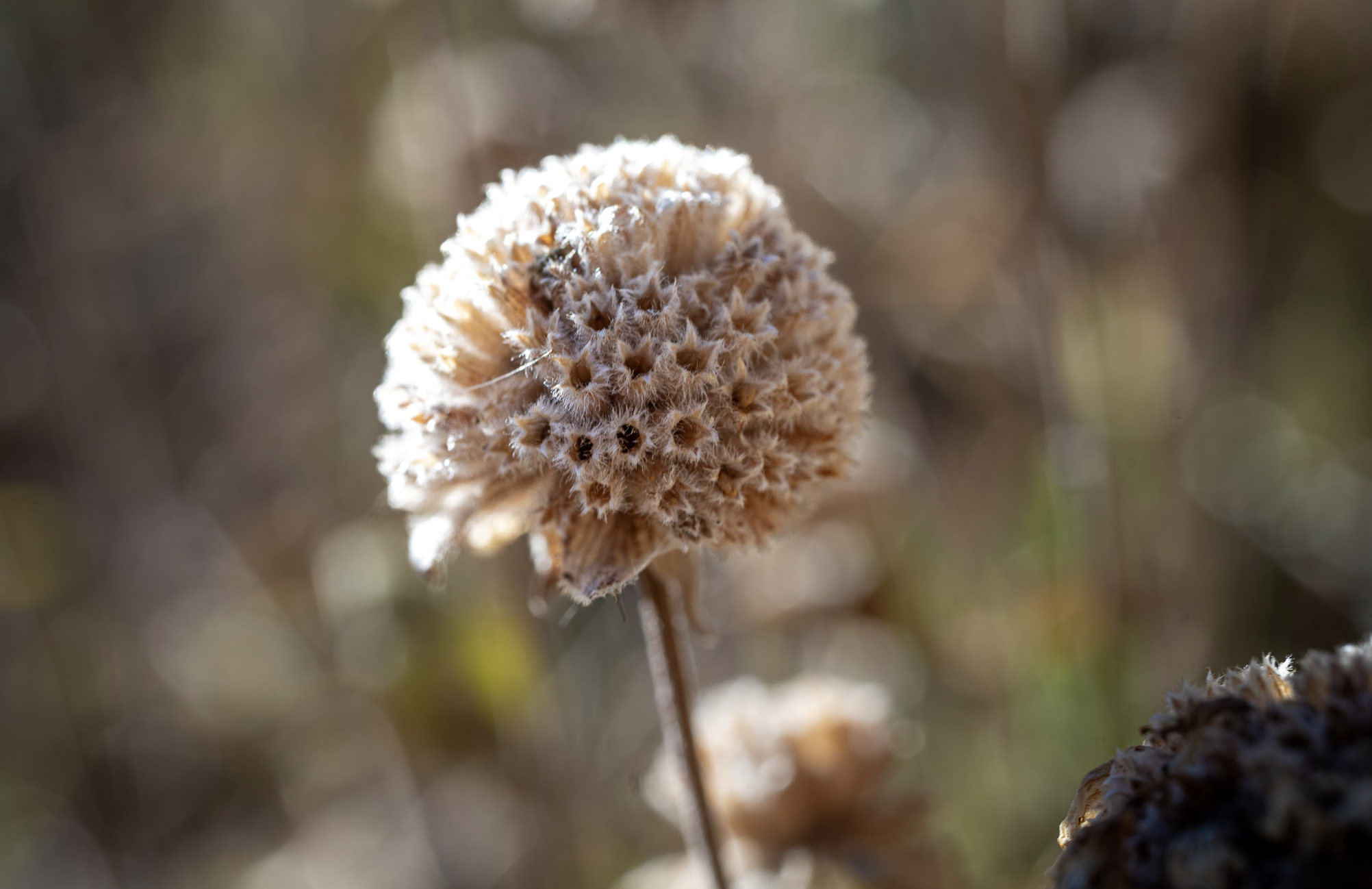
A close up of the seed head on a Mountain pennyroyal (Monardella odoratissima) during seed collection
From roadside to seed bank
The work itself is equal parts fieldcraft and meticulous record-keeping. Each day begins with a cut test: Tori slices open a sample of seed to confirm that it is viable. She records soil samples, slope and aspect, and a botanical description, along with directions precise enough that someone else could find the site again using mileage and landmarks.
Then comes the collecting, which varies by species. Blue wildrye can be bent over and shaken into a bucket; penstemon seed heads have to be picked one at a time.
Back at the office, Tori weighs out two grams, counts the seeds, and runs a second viability test to estimate the collection’s pure live seed. The seed is dried—sometimes spread across newspaper, sometimes simply left in its brown paper bag—and then rough-cleaned. A seed cleaner separates seed from chaff and stems, an important step because cleaning facilities charge based on the material being processed, and stems and other bulky material add up quickly.
Each collection is then bagged, labeled with an identification number, and boxed for an assigned facility, where it can move into long-term storage, research, or amplification. When the need arises, Lassen has first claim on amplified seed from its own collections.
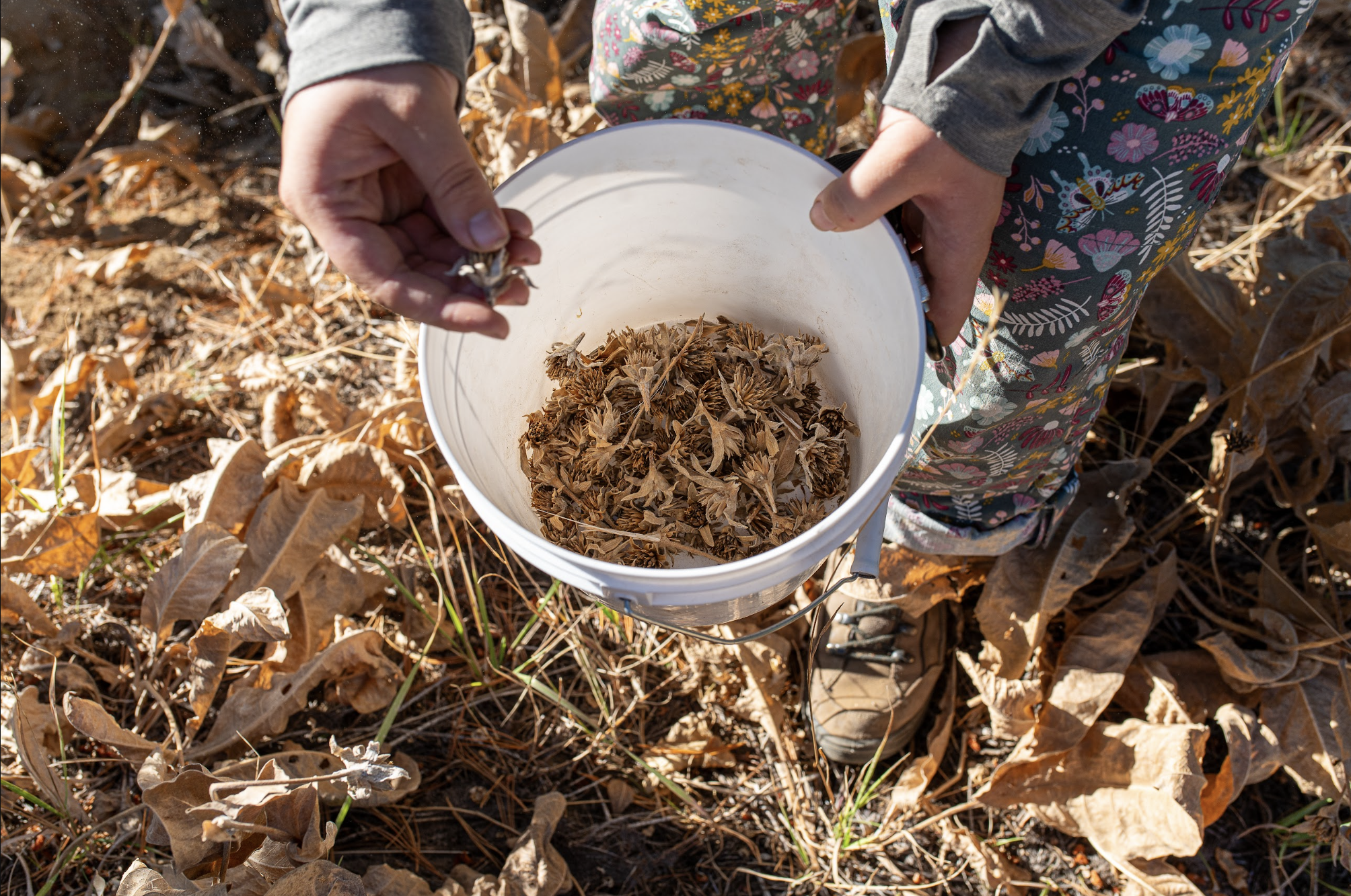
Tori collects Wooly Mule’s Ears (Wyethia mollis) seeds at one of the collection site in Lassen Volcanic National Park
Why it matters
After the Dixie and Camp fires, vast areas of soil across Plumas, Butte, and Lassen counties sit bare beneath full sun. Native grasses and forbs are among the first lines of defense for that ground and, by extension, for the watersheds and fish downstream.
The trees may take generations to return. But the groundwork, quite literally, comes first.
“This program creates a sense of stability in really unforeseen times,” Tori said. “It also creates community, and this ability to rely on other people’s collections.”
That may be the quiet power of a seed bank. When the next fire comes—or when something as seemingly minor as a car leaving the road wipes out a roadside population—Lassen will have seed collected from its own landscape, preserved and ready to return to the ground.
The forest may take generations to come back. The first pieces of its recovery can be waiting in a paper bag.
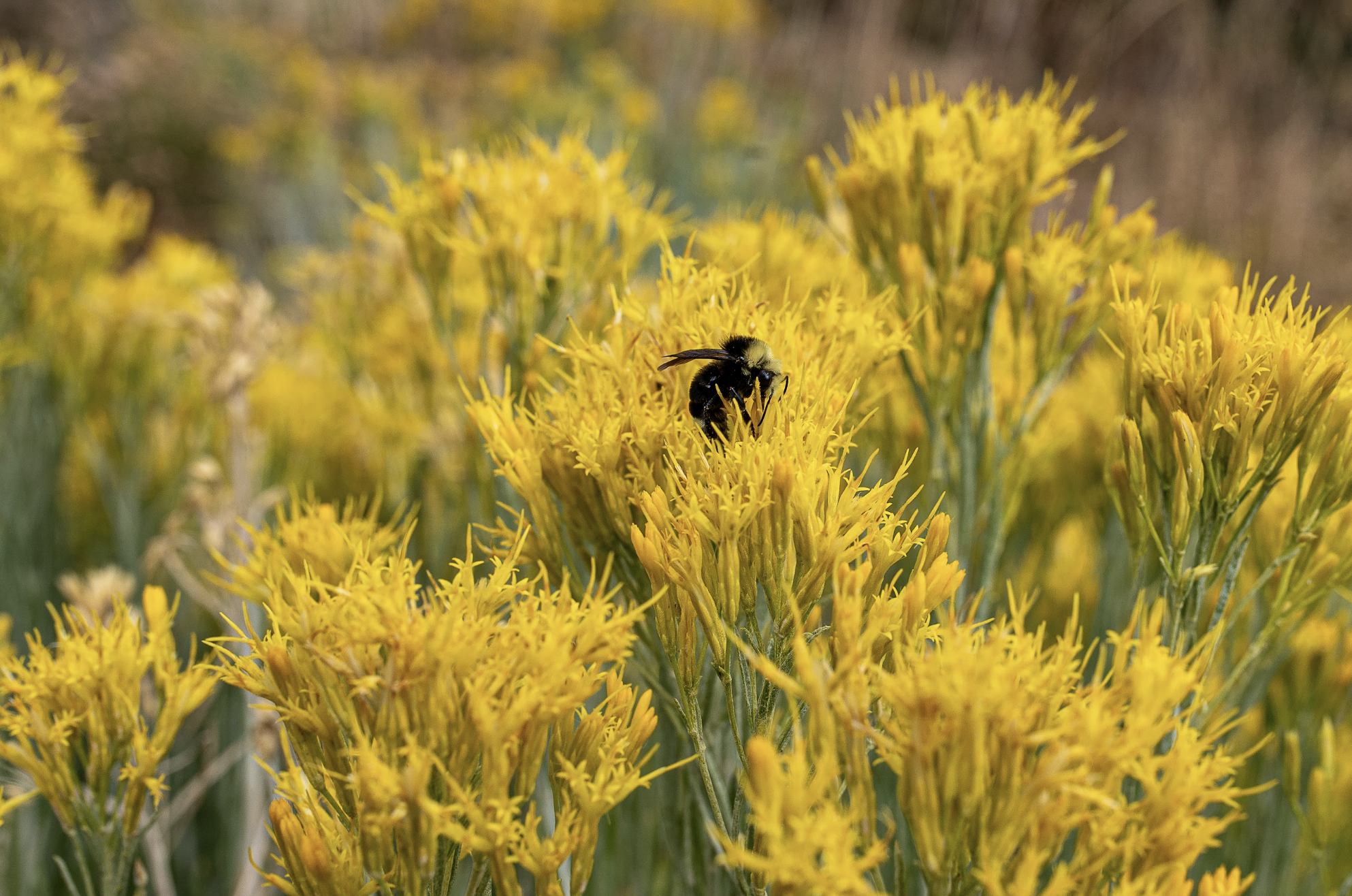
A Cuckoo bumblebee on Rubber rabbitbrush (Ericameria nauseosa) in an unburned area of Lassen National Volcanic National Park
Related Posts
-
Community Based Natural Resource Management

-
Aug 19, 2026

What Is a Collaborative, and Why Does It Matter for Land Management?
Many thinned forests and restored meadows you drive past in Lassen, Plumas, or Butte County have a backstory: years of…
-
Community Based Natural Resource Management
-
Jun 25, 2026
Lake Almanor’s Recovery After the Dixie Fire: What the Water Is Telling Us
If you've spent time around Lake Almanor over the last few years, you've probably noticed how much the landscape has…
-
Community Based Natural Resource Management
-
Jun 15, 2026
Conserving Mount Lassen Paintbrush at Swain Meadow
This month, staff from Sierra Institute, the Lassen National Forest, and the Institute of Applied Ecology gathered at Swain Meadow…
-
Community Based Natural Resource Management
-
Jun 4, 2026
SCALE 2026
Sierra Institute is excited to announce that registration for SCALE 2026 is now open! SCALE is a network of collaboratives…
-
Community Based Natural Resource Management
-
Apr 2, 2026
Living and Rebuilding in the WUI: Rethinking Wildfire Resilience as a Community
What it really means to live, rebuild, and belong in the Wildland-Urban Interface.


